Current Clients
Meet Our Clients
Our clients have been wrongfully convicted because of issues including but not limited to the following: eyewitness misidentification, flawed forensic science, unreliable experts, false informants, government misconduct, and inadequate defense.
- County of Conviction: Fayette County
- Conviction: First Degree Murder
- Sentence: Life without mercy
- Time Served: 31 Years
- WVIP Involvement: Client, State Habeas Petition
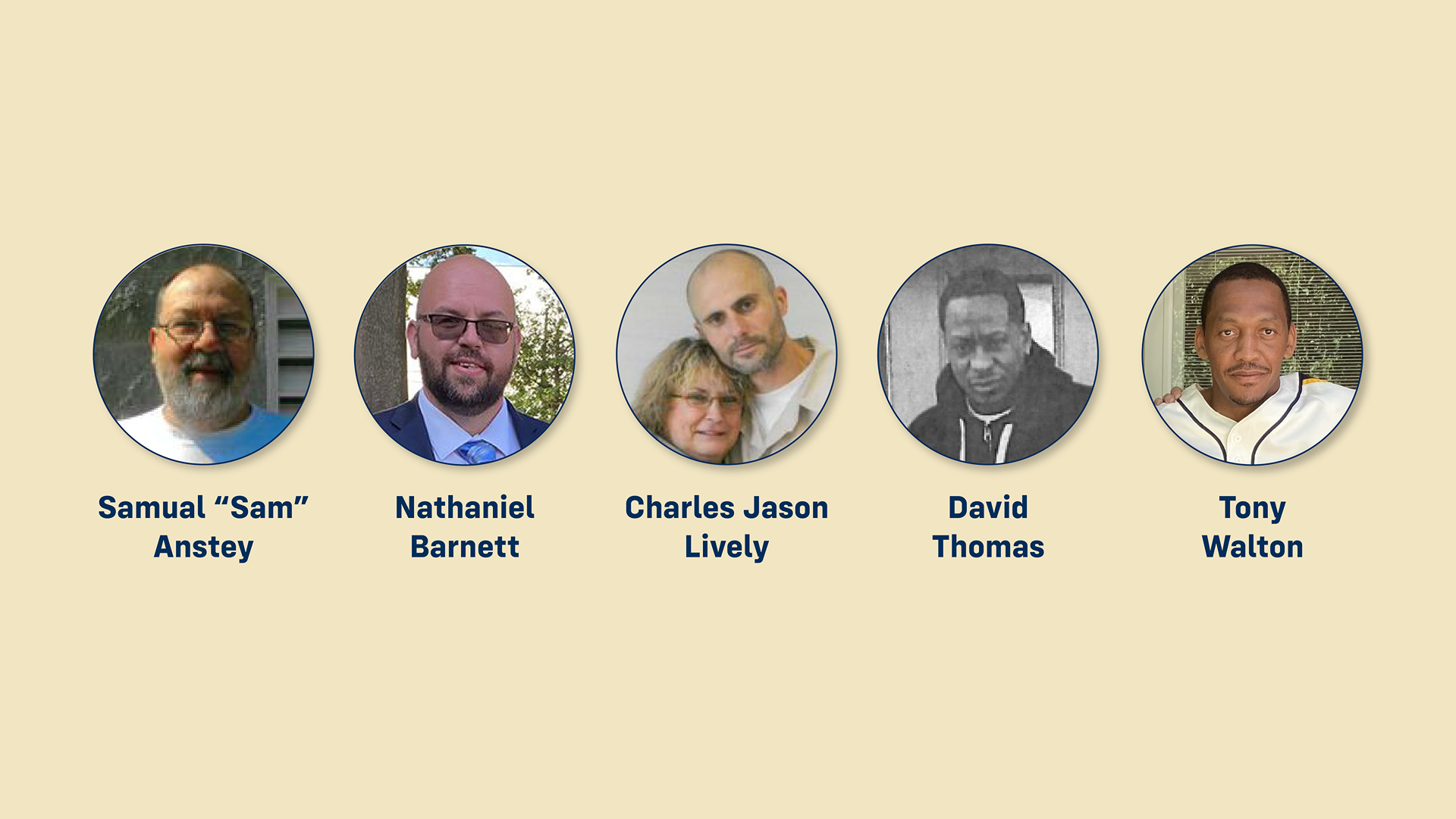
Sam is an innocent man who has spent half his life incarcerated in state prison for a crime he did not commit. Following a fire in the trailer he shared with his grandmother, investigators identified what they believed to be evidence of arson. Sam was indicted and convicted of First-Degree Murder by Arson.
Four investigators examined the scene, each making grave errors in the preservation of the scene and the evidence, which destroyed the reliability and accuracy of the conclusion that Sam started the fire.
Sam filed for post-conviction relief in 2014 to expose the outdated and erroneous science used to convict him. His petition was denied without a hearing.
Continuing investigation and recent changes in post-conviction law have reinvigorated the case. Armed with new evidence, WVIP will be filing a new post-conviction petition on Sam’s behalf. While he has yet to convince a court to hear his evidence, Sam is consistently and continuously fighting for a chance to rectify his wrongful conviction and gain his freedom.
- County of Conviction: Cabell
- Convicted of: Second Degree Murder
- Ultimate Sentence: Voluntary Manslaughter
- Time served: 8 years
- WVIP Involvement: Exonerated Client
Nathaniel Barnett was convicted of second-degree murder in 2008 in Cabell County along with his brother, Philip Barnett, and Justin Black.
In 2016, the court granted post-conviction DNA testing of evidence collected from the deceased which identified the sole contributor to the sample was a convicted sex offender T.S., someone unknown to Nathan or his co-defendants. Following that discovery, Nathan, Philip, and Justin filed post-conviction motions to overturn their convictions.
On May 1, 2019, the three co-defendants’ convictions were vacated and on October 5, 2021, the state dismissed the charges against Nathan, Philip, and Justin. The state declined to pursue charges against. T.S.
- County of Conviction: McDowell
- Convicted of: First Degree Murder and First Degree Arson
- Sentence: Life with Mercy
- Time Served: 14 years
- WVIP Involvement: Exonerated Client
Charles Jason Lively is an innocent man who spent 14 years of his life incarcerated due to false fire “science” testimony.
Jason was convicted of First Degree Murder and First Degree Arson in 2007 for the murder of Dr. Ebb K. “Doc” Whitley at his home in Iaeger, West Virginia on March 15, 2005. The fire expert hired by the state in post-conviction, Dr. Craig Beyler, found the fire was not arson. Additional testing by Dr. Glen Jackson, another state expert, corroborated Dr. Beyler’s opinion that the fire was not incendiary.
The West Virginia Innocence Project worked with attorneys at Baker Botts L.L.P. to prove Mr. Lively’s innocence.
On September 23, 2020, Jason’s conviction was finally vacated after his attorneys filed an Unopposed Motion to Vacate Convictions in McDowell County Circuit Court, which was granted. Jason now resides with his fiancée, Billie Jo Blankenship, in North Carolina.
- County of Conviction: Ohio
- Convicted of: First Degree Sexual Assault
- Sentence: 25-100 years
- Time Served: 8 years
- WVIP Involvement: Client, State Habeas Petition
In 2017, David Thomas was wrongly identified as the perpetrator in a sexual assault. Following a trial plagued with constitutional violations, David was convicted and has spent the last 8 years attempting to clear his name. Since 2023, the West Virginia Innocence Project has been investigating his case and has uncovered significant issues with evidence and police investigation, including timeline discrepancies and witness misidentification. Further, numerous errors by his trial counsel directly led to his wrongful conviction**.**
WVIP is currently preparing a petition for habeas corpus challenging his incarceration. David looks forward to an evidentiary hearing where he can finally clear his name in the hopes that the police will discover the true perpetrator.
- County of Conviction: Fayette
- Convicted of: Armed Robbery and Assault
- Sentence: 52-60 years
- Time Served: 16 years
- WVIP Involvement: Client, State Coram Nobis Petition
Tony Walton was wrongfully convicted of armed robbery in Mt. Hope, WV in 2012 at just 27 years old.
Errors in the initial investigation led to an eyewitness misidentifying Tony as the perpetrator. That mistake, combined with the use of flawed forensic techniques surrounding alternative light source technology and an inexperienced defense attorney, led the jury to convict Tony despite the lack of concrete evidence.
Armed with expert reports from leading experts, including former FBI agent David Alford, WVIP has been fighting in court for Tony’s exoneration since 2022.
Tony was granted parole in 2024 and was released from parole a year later. Despite clear evidence of wrongful conviction, Tony has yet to be granted a hearing wherein he can prove his innocence.
Eyewitness Misidentification
Far and away the most common contributing factor, eyewitness misidentifications have played a role in approximately 70% of the over 300 DNA exonerations that have occurred since the early 1990s.
Memory is malleable and fallible. The human brain does not record memories like a video camera. Over 100 years of scientific studies have called into question the validity and reliability of eyewitness testimony, particularly when it comes to identifying perpetrators. In the last several decades, law enforcement agencies across the county have adopted procedures that help guard against mistaken identifications. These revised procedures include conducting live and photo lineups in a sequential (vs. simultaneous) manner and making sure that the lineup is “double-blind” that is, conducted by an individual who does not know where the suspect falls in the lineup sequence.
Unreliable or Improper Forensic Science
Unlike DNA analysis, most forensic science techniques were developed solely with an eye towards solving crimes. Even though many of these disciplines are cloaked in air of scientific authority, they typically lack the key hallmarks of sound science. A 2009 report prepared by the National Academy of Sciences examined a number of forensic disciplines – including microscopic hair comparison, toolmark and impression evidence, and bite mark analysis – and concluded that, with the exception of DNA evidence, every discipline lacked sufficient indicia of validity (ability of the method to produce an accurate result) and reliability (ability of the method to produce consistent results). Certain arson investigation techniques are also faulty.
In addition to the inherent problems with forensic science itself, experts in these fields will sometimes testify to conclusions beyond even what the limited science on their subject allows, by indicating that two samples were a “match” or “consistent with each other” when there is no way to prove the sample could not be matched or be consistent with samples from other individuals. Finally, although most forensic experts—even those in undeveloped forensic disciplines—are honest, hardworking individuals just trying to do their jobs, there have been some instances of outright fraud and misconduct.
False Confessions
In 25% of DNA exonerations, defendants made incriminating statements, confessed, or pleaded guilty to crimes they did not commit. Typically the result of coercive or suggestive interrogation techniques, false confessions may be given due to the threats or promises made during the interrogation; extended periods of time without food, drink, or sleep; diminished capacity or mental impairment; youth; ignorance of the law; denial of Fifth Amendment right to counsel during interrogation; simple misunderstanding; suggestive lines of questioning; and torture. Like eyewitness identifications, procedures and guidelines have been developed for interrogations—such as video recording all interrogations completely—to reduce the instances of false confession and ensure proper interrogation techniques are used.
Unreliable Informant Testimony
In more than 15% of DNA exonerations, an informant testified against the defendant. These informants often have incentives to take the stand, which may not be disclosed to the jury—such as payment, avoiding criminal prosecution, or reducing a sentence. They may testify in multiple cases and use nefarious means to gather information necessary to support their false testimony.
Bad Lawyering
Ineffective, incompetent, and overburdened defense counsel often allows the various other factors leading to wrongful convictions to go unchallenged in court. Failing to investigate alibis or challenge shoddy forensic evidence, failing to file pretrial motions, failing to prepare opening statement or closing argument, and sleeping during trial are all examples ineffective assistance of counsel that led the convictions of innocent defendants later exonerated by DNA evidence.